
Recogne: the German cemetery and the Native American memorial
Just north of Bastogne, the village of Recogne holds two very different places of remembrance: the graves of the young men who fought on the other side, and a tribute to the Native Americans who fought for the United States.
Updated September 27, 2026 · By the info-lux newsroom, Bastogne
The German military cemetery of Recogne holds 6,807 German soldiers. The youngest was 17 and the oldest 52. It was first set up by the U.S. Army, which buried its own dead and about 3,000 German soldiers here. The American graves were later moved to Henri-Chapelle and Neupré. Nearby, a stone memorial to Native American soldiers, erected in 1994 for the 50th anniversary, mainly honors Oglala Lakota soldiers. Both are free, 5 minutes from Bastogne.
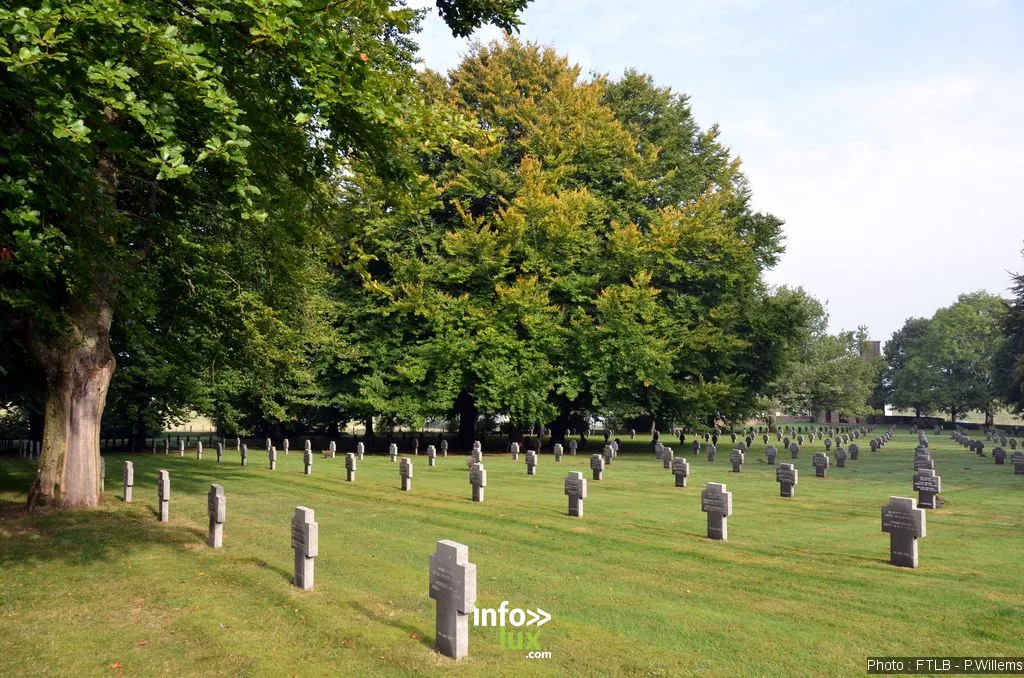
A cemetery started by Americans
During and after the battle, the U.S. Army used a field at Recogne to bury the dead: its own soldiers, and nearly 3,000 German soldiers killed in the Ardennes offensive and along the German border. After the war, the American dead were moved to the permanent American cemeteries at Henri-Chapelle and Neupré (Neuville-en-Condroz). The Germans stayed. Isolated graves from across the region were then gathered here, bringing the total to 6,807.
The cemetery is maintained by the Volksbund, the German war graves commission. Dark stone crosses, each marking several soldiers, stand under tall trees. The ages on the stones show how desperate Germany's last mobilization was. It is a quiet place, and many American visitors find it an important counterpoint to the Mardasson.
The Native American memorial
On the hills above Recogne, next to a bison farm with a log-cabin facade, a stone monument with a carved Native American head is surrounded by amulets and dreamcatchers left by visitors. It was erected in 1994, for the 50th anniversary of the Battle of the Bulge. Most of the Native American soldiers who fought in the area were Oglala Lakota. Native Americans served in every theater of World War II, including the famous code talkers, whose radio codes were never broken.
Inside the 101st Airborne Museum, a diorama and personal items, including a medicine bag, honor a Native American soldier who came back to Bastogne.
Visitor tips
- Both sites are free. The cemetery is open during daylight hours year-round, with parking at the entrance.
- No picnics and no dogs off leash in the cemetery.
- Combine with the Bois Jacques foxholes, a few minutes away.
Practical information
| Location | Recogne, municipality of Bastogne (5 minutes north of downtown on the N30) |
|---|---|
| Burials | 6,807 German soldiers |
| Maintained by | Volksbund Deutsche Kriegsgräberfürsorge |
| Admission | Free, daylight hours, year-round |
| GPS (cemetery) | 50.04912, 5.74165 |
Frequently asked questions
How many soldiers are buried at Recogne?
6,807 German soldiers who died in World War II, aged 17 to 52.
Were Americans buried at Recogne?
Yes, temporarily. The U.S. Army first buried its dead there, along with about 3,000 German soldiers. The American remains were later moved to the Henri-Chapelle and Ardennes (Neupré) American cemeteries.
Is there a Native American memorial near Bastogne?
Yes. In Recogne, a stone memorial with a carved Native American head honors Native American soldiers of the Battle of the Bulge, mostly Oglala Lakota. It was erected in 1994.
Sources: Maison du Tourisme du Pays de Bastogne, Volksbund, info-lux history article by Philippe Gruslin (September 2026). Opening hours and prices change: check the official website before your visit. Written in English by the info-lux newsroom, independent regional news media based in the Belgian province of Luxembourg.